
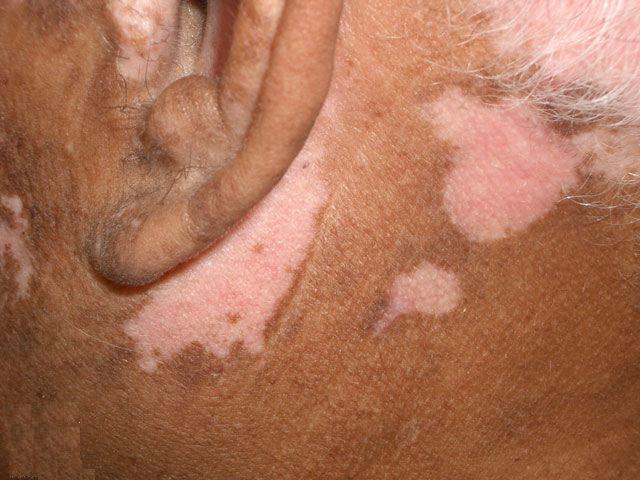
Vitiligo is an autoimmune disease in which pigment cells (melanocytes) are destroyed, resulting in irregularly shaped white patches on the skin.
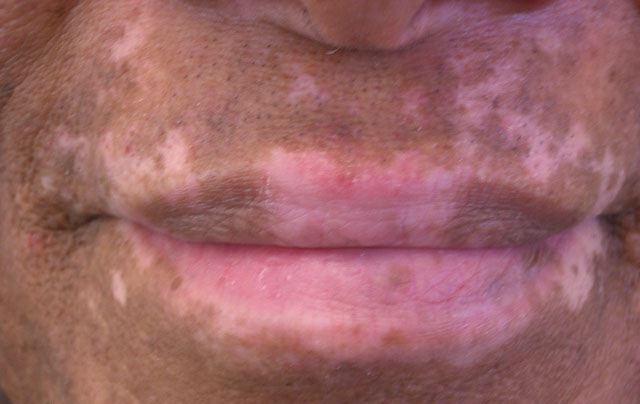
Any part of the body may be affected. Common sites are exposed areas (face, neck, eyes, nostrils, nipples, navel, genitalia), body folds (armpits, groin), sites of injury (cuts, scrapes, burns) and around pigmented moles (halo naevi).
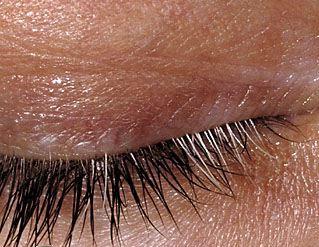
The hair may also go grey early on the scalp, eyebrows, eyelashes and body. White hair is called ‘poliosis’. The retina may also be affected.
Who is prone to vitiligo?
Vitiligo affects at least 1% of the population, and occurs in all races. In half of sufferers, pigment loss begins before the age of 20. In one fifth, other family members also have vitiligo.
Even though most people with vitiligo are in good general health, they face a greater risk of having other autoimmune diseases such as diabetes, thyroid disease, pernicious anaemia (B12 deficiency), Addison's Disease (adrenal gland disease) and alopecia areata (round patches of hair loss).
Melanin is the pigment that determines the colour of skin, hair, and eyes. It is produced in cells called melanocytes. If melanocytes cannot form melanin or if their number decreases, skin colour will become progressively lighter.
The cause of vitiligo is not known. It sometimes follows physical injury such as sunburn, or emotional stress. There are three theories on the cause of vitiligo:
The severity of vitiligo differs with each individual. Light skinned people usually notice the pigment loss during the summer as the contrast between the affected skin and sun tanned skin becomes more distinct. People with dark skin may observe the onset of vitiligo any time. In a severe case pigment may be lost from the entire body. The eyes do not change colour. There is no way to predict how much pigment an individual will lose.
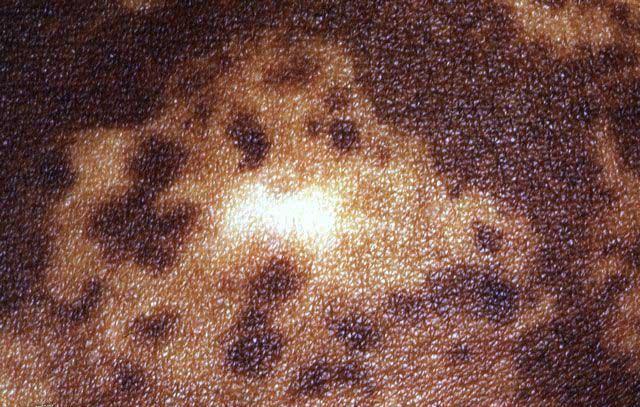
The degree of pigment loss can vary within each vitiligo patch which means that there may be different shades of brown in a vitiligo patch. This is called ‘trichrome’. A border of darker skin may circle an area of light skin.
Vitiligo frequently begins with a rapid loss of pigment which may be followed by a lengthy period when the skin colour does not change. Later, the pigment loss may begin again. The loss of colour may continue until, for unknown reasons, the process stops. Cycles of pigment loss followed by periods of stability may continue indefinitely.
Other causes of white skin (leukoderma) include severe trauma, burns, and deep skin infections.
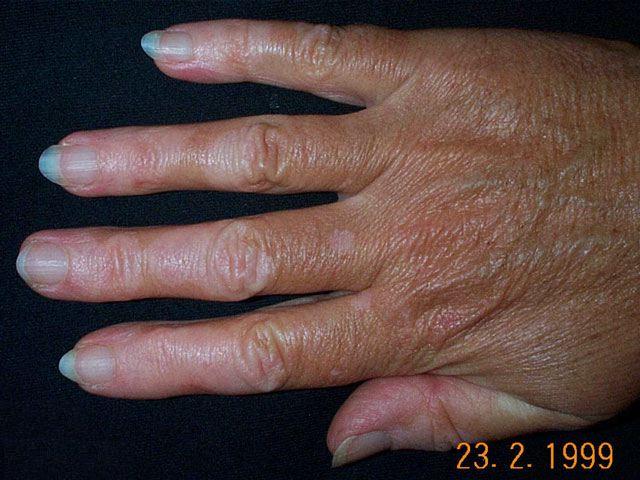
Those prone to vitiligo should be careful to minimise skin injury as it is common for healing to result in a new white patch at the site. The injury might be a cut, a graze, an area prone to rubbing. It has been reported to arise where jewellery or clothing items irritate the skin.
The white skin needs sun protection because it can only burn, it cannot tan. The normal skin also needs protecting to prevent sunburn (which could cause spreading of the vitiligo), and to reduce the contrast between the normal and the white skin.
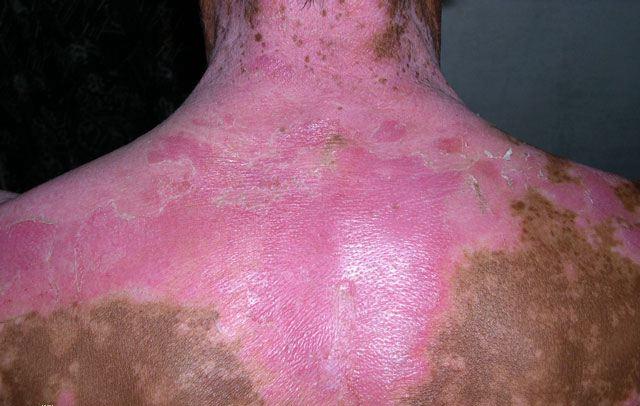
Treatment is currently not very satisfactory.
If a dark skinned person has vitiligo affecting a large part of the exposed areas, he or she may wish to undergo depigmentation. A cream containing monobenzyl ether of hydroquinone is applied to the skin. This causes all the skin to lose its pigment. Its effect is usually permanent.