
Stretch Marks妊娠紋
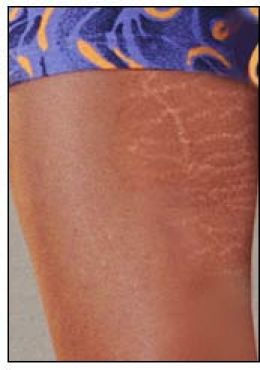
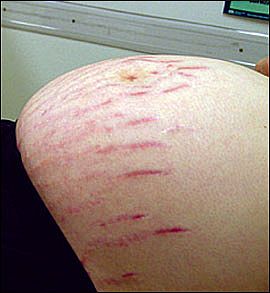
Stretch marks or striae (singular stria), as they are called in dermatology, are a form of scarring on the skin with an off-color hue. They are caused by tearing of the dermis, and over time can diminish but not disappear completely. Stretch marks are the result of the rapid stretching of the skin associated with rapid growth (common in puberty) or weight gain (e.g. pregnancy and/or muscle building) that overcomes the dermis's elasticity. Although stretch marks are generally associated with pregnancy and obesity, they can also develop during rapid muscle growth. Medical terminology for these kinds of markings includes striae atrophicae, vergetures, stria distensae, striae cutis distensae, striae gravidarum (in cases where it is caused by pregnancy), lineae atrophicae, striae distensae, linea albicante, or simply striae.
Symptoms and signs
They first appear as reddish or purple lines, but tend to gradually fade to a lighter color. The affected areas appear empty and are soft to the touch.
Stretch marks occur in the dermis, the resilient middle layer that helps the skin retain its shape. No stretch marks will form as long as there is support within the dermis. Stretching plays more of a role in where the marks occur and in what direction they run. Stretching alone is not the cause.
Stretch marks can appear anywhere on the body, but are most likely to appear in places where larger amounts of fat are stored. Most common places are the abdomen (especially near the belly-button), breasts, upper arms, underarms, thighs (both inner and outer), hips, and buttocks. They pose no health risk in and of themselves, and do not compromise the body's ability to function normally and repair itself.
Prevention and removal
Between 75% and 90% of women develop stretch marks to some degree during pregnancy. The sustained hormonal levels as a result of pregnancy usually means stretch marks may appear during the sixth or seventh month.
Only one randomised controlled study has been published which claimed to test whether oils or creams prevent the development of stretchmarks. This study found a daily application of a cream (Trofolastin) containing Centella asiatica extract, vitamin E, and collagen-elastin hydrolysates was associated with fewer stretch marks during pregnancy. Another study, though lacking a placebo control, examined a cream (Verum) containing vitamin E, panthenol, hyaluronic acid, elastin and menthol. It was associated with fewer stretch marks during pregnancy versus no treatment.
Though cocoa butter is an effective moisturizer, no research studies have shown its ability to either prevent stretchmarks, or to reduce their appearance once a stretchmark has already formed.
Various treatments are available for the purpose of improving the appearance of existing stretch marks, including laser treatments, dermabrasion, and prescription retinoids. Some cream manufacturers claim the best results are achieved on recent stretch marks; however, few studies exist to support these claims.
A study in the journal Dermatologic Surgery showed that radiofrequency combined with 585-nm pulsed dye laser treatment gave "good and very good" subjective improvement in stretch marks in 33 of 37 patients, although further studies would be required to follow up on these results. In addition, the use of a pulsed dye laser was shown to increase pigmentation in darker skinned individuals with repeated treatments.
A surgical procedure for removing lower abdominal stretch marks is the tummy tuck, which removes the skin below the navel where stretch marks frequently occur.
A new modality, fractional laser resurfacing, offers a novel approach to treating striae. Using scattered pulses of light only a fraction of the scar is zapped by the laser over the course of several treatments. This creates microscopic wounds and as such is a "no downtime" procedure. The body responds to each treatment by producing new collagen and epithelium.