Scarring疤痕
Scars (also called cicatrices) are areas of fibrous tissue that replace normal skin (or other tissue) after injury. A scar results from the biologic process of wound repair in the skin and other tissues of the body. Thus, scarring is a natural part of the healing process. With the exception of very minor lesions, every wound (e.g. after accident, disease, or surgery) results in some degree of scarring.
Scar tissue is not identical to the tissue that it replaces and is usually of inferior functional quality. For example, scars in the skin are less resistant to ultraviolet radiation, and sweat glands and hair follicles do not grow back within scar tissue. A myocardial infarction, commonly known as a heart attack, causes scar formation in the heart muscle, which leads to loss of muscular power and possibly heart failure. However, there are some tissues (e.g. bone) that can heal without any structural or functional deterioration.
Scar formation is a natural part of the healing process after injury.
Various factors influence how your skin scars. Of course, the depth and size of the wound or incision and the location of the injury are going to impact the scar's characteristics. But your age, heredity, even your sex or ethnicity, will all affect how your skin reacts.
These are several different types of scars including:
Keloid scars. These scars are the result of an overly aggressive healing process. These scars extend beyond the original injury. Over time, a keloid scar may affect mobility. Possible treatments include surgical removal, or injections with steroids. Smaller keloids can be treated using cryotherapy (freezing therapy using liquid nitrogen). You can also prevent keloid formation by using pressure treatment or gel pads with silicone when you sustain an injury. Keloid scars most often occur in Blacks.
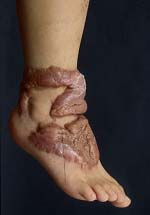
Contracture scars. If your skin has been burned, you may have a contracture scar, which causes tightening of skin that can impair your ability to move; additionally, this type of scar may go deeper to affect muscles and nerves.
Hypertrophic scars. Raised and red scars that are similar to keloids, but do not breach the boundaries of the injury site. Possible treatments can include injections of steroids to reduce inflammation.
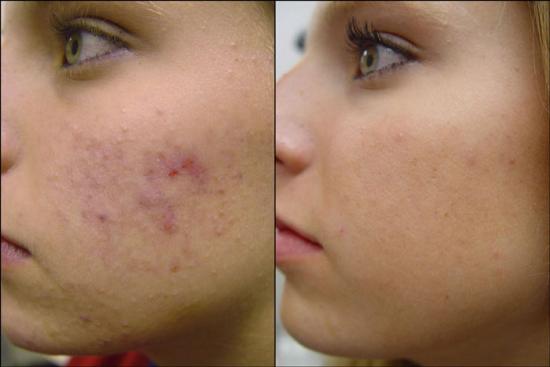
Acne scars. If you've had severe acne, you probably have the scars to prove it. There are many types of acne scars, ranging from deep pits to scars that are angular or wavelike in appearance. Possible treatments will depend on the types of acne scars you have.
What are the possible treatments?
The treatments for scars will vary depending on multiple factors. Scar treatments may include:
Over-the-counter or
prescription creams, ointments or gels.
These products can be used to treat scars that are caused from surgical
incisions or other injuries or wounds. If you are under the care of a plastic
surgeon and your scarring is the result of cosmetic or
plastic surgery,
ask your surgeon for his or her recommendation if
over-the-counter
treatment is sufficient; otherwise, he or she will prescribe that which best
suits your personal case. Oftentimes, treatments can include corticosteroids or
certain antihistamine creams for scars that cause itching and are extremely
sensitive.
Likewise, if you are under the care of a dermatologist for severe acne and have
scarring as a result of acne, you should ask your doctor for his or her
recommendation if you haven't already received it. Your doctor can also
recommend or use pressure treatings or silicone gel sheetings to help treat
scars or as preventative care.
Surgical removal or treatment. There are many options to treat deeper wounds and scars depending on your particular case: skin grafts, excision, dermabrasion or laser surgery. You can receive a skin graft, where the surgeon removes skin from another area of your body. This is often used in the case of burn victims. If you've got scarring that impairs function, surgery can help address those problems. Like other surgeries, you and your doctor will determine together if you will have local anesthesia with an oral sedative or general anesthesia that will put you to sleep. If you've recently undergone plastic, cosmetic or other surgery that has caused your scars, it is best that you wait at least one year before making a decision about scar treatment. Many scars fade and become less noticeable over time.
Injections.
In the case of protruding scars such as keloids or hypertrophic, your doctor may
elect to use steroid injections. He or she may use this as a stand-alone
treatment, or in conjunction with other treatments.
Other types of injects, such as collagen injections or other "fillers," may be
useful for some types of pitted scarring although these are not usually
permanent solutions.
If your scar is physically impairing you in any way, you may be able to get coverage from your insurance carrier. You can ask your doctor to write a letter detailing your particular case, such as if you are a burn victim. He or she can also take photos to help prove your case. If you are undergoing scar treatment for cosmetic purposes, you will most likely have to pay for it all yourself. If your scars are caused from cosmetic surgery, make sure you understand all the implications of insurance coverage for any elective surgery that is not medically necessary.