



Psoriasis牛皮廯
What is Psoriasis?
Psoriasis is an inflammatory skin condition. There are five types, each with unique signs and symptoms. Between 10% and 30% of people who develop psoriasis get a related form of arthritis called “psoriatic arthritis,” which causes inflammation of the joints.
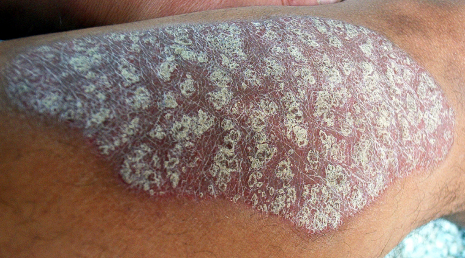
Plaque
psoriasis is the most common type of psoriasis. About 80% of people who develop
psoriasis have plaque psoriasis, which appears as patches of raised, reddish
skin covered by silvery-white scale. These patches, or plaques, frequently form
on the elbows, knees, lower back,
and scalp. However, the plaques can occur anywhere on the body.
The other
types are guttate psoriasis (small, red spots on the skin),
pustular psoriasis (white pustules surrounded by red skin), inverse psoriasis
(smooth, red lesions form in skin folds), and erythrodermic psoriasis
(widespread redness, severe itching, and pain).
Regardless of type, psoriasis usually causes discomfort. The skin often itches, and it may crack and bleed. In severe cases, the itching and discomfort may keep a person awake at night, and the pain can make everyday tasks difficult.
Psoriasis is a chronic, meaning lifelong, condition because there is currently no cure. People often experience flares and remissions throughout their life. Controlling the signs and symptoms typically requires lifelong therapy.
Treatment depends on the severity and type of psoriasis. Some psoriasis is so mild that the person is unaware of the condition. A few develop such severe psoriasis that lesions cover most of the body and hospitalization is required. These represent the extremes. Most cases of psoriasis fall somewhere in between.
Causes
Psoriasis
may be one of the oldest recorded skin conditions. It was probably first
described around 35 AD. Some evidence indicates an even earlier date. Yet, until
recently, little was known about psoriasis.
While scientists still do not fully know what causes psoriasis, research has significantly advanced our understanding. One important breakthrough began with the discovery that kidney-transplant recipients who had psoriasis experienced clearing when taking cyclosporine. Since cyclosporine is a potent immunosuppressive medication, this indicates that the immune system is involved.
Immune Mediated. Researchers now believe that psoriasis is an immune-mediated condition. This means the condition is caused by faulty signals in the body’s immune system. It is believed that psoriasis develops when the immune system tells the body to over-react and accelerate the growth of skin cells. Normally, skin cells mature and are shed from the skin’s surface every 28 to 30 days. When psoriasis develops, the skin cells mature in 3 to 6 days and move to the skin surface. Instead of being shed, the skin cells pile up, causing the visible lesions.
Genes. Researchers have identified genes that cause psoriasis. These genes determine how a person’s immune system reacts. These genes can cause psoriasis or another immune-mediated condition, such as rheumatoid arthritis or type 1 diabetes. The risk of developing psoriasis or another immune-mediated condition, especially diabetes or Crohn’s disease, increases when a close blood relative has psoriasis.
Family History. Some people who have a family history of psoriasis never develop this condition. Research indicates that a “trigger” is needed. Stress, skin injuries, a strep infection, certain medications, and sunburn are some of the known potential triggers. Medications that can trigger psoriasis are anti-malarial drugs, beta-blockers (medication used to treat high blood pressure and heart conditions), and lithium. Dermatologists have seen psoriasis suddenly appear after a person takes one of these medications, gets a strep infection, or experiences another trigger.
Psoriasis research continues to accelerate at a rapid pace and will continue to advance our knowledge of what causes psoriasis.
Quality
of Life
All types of psoriasis, ranging from mild to severe, can affect a person’s
quality of life. Living with this lifelong condition can be physically and
emotionally challenging.
Itching, soreness, and cracked and bleeding skin are common. Nail psoriasis can be painful. Even the simple act of squeezing a tube of toothpaste can hurt. One woman described her psoriasis as feeling like “a bad sunburn that won’t go away.”
Several studies have shown that people often feel frustrated. In some cases, psoriasis limits activities and makes it difficult to perform job responsibilities. The National Psoriasis Foundation reports that 56 million work hours are lost each year by those who have psoriasis. Additionally, a survey conducted by the National Psoriasis Foundation in 2002 indicates that 26% of people living with moderate to severe psoriasis have been forced to change or discontinue their normal daily activities.
Studies also have shown that stress, anxiety, loneliness, and low self-esteem are part of daily life for people living with psoriasis. One study found that thoughts of suicide are three times higher for psoriatics than the general population.
Embarrassment is another common feeling. Imagine getting your hair cut and noticing that the stylist or barber is visibly uncomfortable. What if you extended your hand to someone and the person recoiled? How would you feel if you spent most of your life trying to hide your skin?
Treatment Advances Improve Outlook
With the emergence of several new therapies, including the biologic agents, more
people are experiencing substantial improvements and reporting a greatly
improved quality of life.
Psoriasis: Hand & Feet
Description
Chronic, inflammatory disease due to abnormal T-lymphocyte function. Affects skin, scalp, joint, nails
Treatment
Treatment similar to that for chronic plaque psoriasis, with specific considerations.

Psoriasis of the palms may be indistinguishable from hand eczema. The silvery, dense, scaling plaques are also seen in chronic hand eczema.

This same presentation of round scaling plaques of the dorsum is seem in nummular eczema.

Pustular psoriasis of the palms and soles. Lesions are localized or may involve the entire palms or soles.

Pustular psoriasis lesions resemble dyshidrotic eczema. Pustules evolve to browm spots and end with scaling.